No I Said Again Tuesday of the Other June
This page provides a sociological definition of otherness and how it works in societies. I volition too include examples and resources for people interested in learning more about otherness. I will add to this page over time.
Defining Otherness
The idea of 'otherness' is central to sociological analyses of how majority and minority identities are constructed. This is because the representation of dissimilar groups inside any given order is controlled by groups that take greater political power. In order to empathize the notion of The Other, sociologists kickoff seek to put a disquisitional spotlight on the means in which social identities are constructed. Identities are often thought as being natural or innate – something that nosotros are built-in with – but sociologists highlight that this taken-for-granted view is non true.
Rather than talking about the individual characteristics or personalities of different individuals, which is mostly the focus for psychology, sociologists focus on social identities. Social identities reverberate the fashion individuals and groups internalise established social categories inside their societies, such as their cultural (or ethnic) identities, gender identities, class identities, and and so on. These social categories shape our ideas about who we call back nosotros are, how we want to exist seen by others, and the groups to which nosotros belong.
George Herbert Mead's archetype text, Listen Cocky and Society, established that social identities are created through our ongoing social interaction with other people and our subsequent self-reflection well-nigh who we call up we are according to these social exchanges. Mead's piece of work shows that identities are produced through agreement, disagreement, and negotiation with other people. We adjust our behaviour and our self-prototype based upon our interactions and our self-reflection near these interactions (this is also known as the looking drinking glass self).
Ideas of similarity and deviation are central to the style in which we attain a sense of identity and social belonging. Identities have some element of exclusivity. Just as when we formally join a social club or an organisation, social membership depends upon fulfilling a set of criteria. It just and so happens that such criteria are socially-constructed (that is, created by societies and social groups). As such 'nosotros' cannot vest to any group unless 'they' (other people) do not belong to 'our' group. Sociologists set out to study how societies manage collective ideas about who gets to belong to 'our group' and which types of people are seen as different – the outsiders of society.
Zygmunt Bauman writes that the notion of otherness is cardinal to the way in which societies establish identity categories. He argues that identities are gear up up as dichotomies:
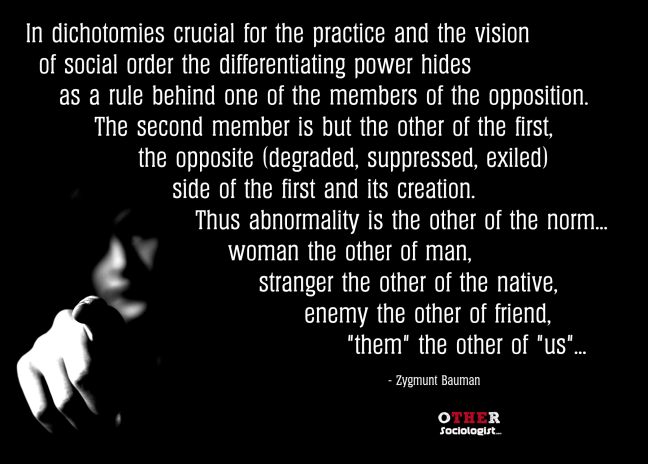
Woman is the other of homo, beast is the other of human, stranger is the other of native, abnormality the other of norm, deviation the other of police force-constant, illness the other of wellness, insanity the other of reason, lay public the other of the expert, greenhorn the other of state subject field, enemy the other of friend (Bauman 1991: eight).
Gender
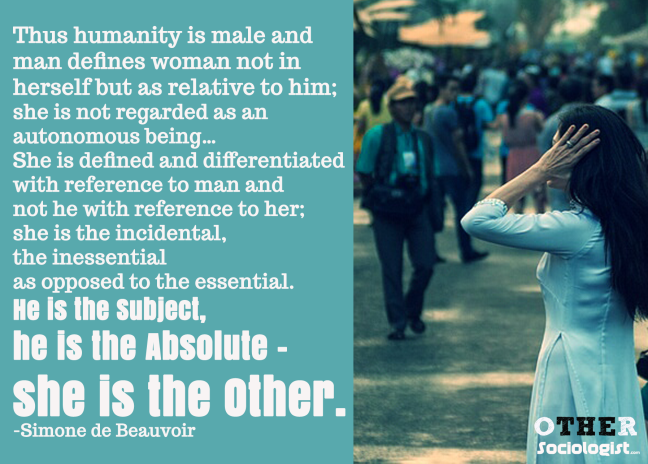
The concept of The Other highlights how many societies create a sense of belonging, identity and social status by constructing social categories every bit binary opposites. This is clear in the social construction of gender in Western societies, or how socialisation shapes our ideas near what information technology means to be a "human" or a "adult female." There is an inherently unequal human relationship betwixt these two categories. Notation that these two identities are ready as opposites, without acknowledging alternative gender expressions. In the early on 1950s, Simone de Beauvoir argued that
Otherness is a central category of man thought. Thus information technology is that no group ever sets itself up equally the One without at once setting up the Other over against itself.
de Beauvoir argued that woman is prepare every bit the Other of man. Masculinity is therefore socially constructed every bit the universal norm by which social ideas almost humanity are divers, discussed and legislated against.
Power
Dichotomies of otherness are fix as being natural and so oftentimes times in everyday life they are taken for granted and presumed to be natural. But social identities are not natural – they represent an established social order – a hierarchy where certain groups are established as being superior to other groups. Individuals have the choice (or agency) to create their identities according to their ain beliefs about the globe. Nonetheless the negotiation of identity as depends upon the negotiation of power relationships. Equally Andrew Okolie puts it:
Social identities are relational; groups typically define themselves in relation to others. This is because identity has little significant without the "other". And then, by defining itself a group defines others. Identity is rarely claimed or assigned for its own sake. These definitions of self and others have purposes and consequences. They are tied to rewards and penalty, which may exist material or symbolic. There is usually an expectation of gain or loss as a effect of identity claims. This is why identities are contested. Power is implicated hither, and because groups do non have equal powers to ascertain both self and the other, the consequences reflect these power differentials. Often notions of superiority and inferiority are embedded in particular identities (2003: 2).
Social institutions such as the constabulary, the media, education, faith and then on hold the balance of power through their representation of what is accustomed as "normal" and what is considered Other. British sociologist Stuart Hall argues that visual representations of otherness concord special cultural authority. In Western countries with a colonial history, similar the Britain, Australia and the USA, whether divergence is portrayed positively or negatively is judged confronting the dominant group – namely White, middle-to-upper class, heterosexual Christians, with cis-men being the default to which Others are judged confronting.
The notion of otherness is used by sociologists to highlight how social identities are contested. Nosotros likewise employ this concept to suspension down the ideologies and resource that groups use to maintain their social identities. Sociologists are therefore interested in the means in which notions of otherness are managed in gild. For instance, we report how some groups become stigmatised equally outsiders, and how such ideas change over fourth dimension. As Dutch-American sociologist Philomena Essed argues, the ability of othering includes opting out of "seeing" or responding to racism.
Notes
This article was start published on fourteen October 2011 and it is a living document, meaning that I will add to it over time.
Learn More
Hither are some of the texts that have influenced my understanding of otherness. Although the concept of "otherness" may non be specifically referenced in these studies, and some of these works cut across several fields of otherness, these authors brand an important contribution to the folklore of minority groups. These texts speak to the historical, cultural and discursive processes through which The Other is constructed in Western contexts. The Other is gear up against the hegemonic "universal human beingness" – that is, white, heart course, heterosexual, able-bodied cis-men.
- Gender
- Race
- Sexuality
- Religion
Gender
- Simone de Beauvoir, The Second Sex. (French republic)
- Floya Anthias and Nira Yuval-Davis, Racialised Boundaries: Race, Nation, Gender, Colour and Class and the Anti-Racist Struggle. (United kingdom of great britain and northern ireland)
- bell hooks, Feminist Theory: From Margin to Centre. (USA)
- bell hooks, Black Looks: Race and Representation. (U.s.a.)
- Gill Bottomley, Marie De Lepervanche, Jeannie Martin (Eds), Intersexions: Gender/Class/Culture/Ethnicity. (Australia)
Race and Civilization
- Ruth Frankenberg, White Women, Race Matters: The Social Construction of Whiteness. (United states)
- Ghassan Hage, White Nation: Fantasies of White Supremacy in a Multicultural Order (Commonwealth of australia)
- Stuart Hall, Representation: Cultural Representations and Signifying Practices (Culture, Media and Identities Series). (United kingdom of great britain and northern ireland)
- Paul Gilroy, The Black Atlantic: Modernity and Double-Consciousness. (United kingdom)
- Paul Gilroy, 'There Ain't no Blackness in the Spousal relationship Jack': The Cultural Politics of Race and Nation. (Britain)
- Peggy McIntosh, White Privilege: Unpacking the Invisible Knapsack. (Us)
- Margaret Wetherell and Jonathan Potter, Mapping the Language of Racism: Discourse and the Legitimation of Exploitation (New Zealand)
Sexuality
- Judith Butler, Gender Trouble: Feminism and the Subversion of Identity. (USA)
- Michel Foucault, The History of Sexuality. (France)
- Adrienne Rich, Compulsory Heterosexuality and Lesbian Experience. (Usa)
- Comprehensive List of LGBTQ+ Term Definitions. Sam Killermann for Everyday Feminism.
Religion*
- Edward W. Said. Orientalism. (U.s., on Islam)
- Gary Bouma. Gender and Religious Settlement: Families, Hijabs and Identity. (Australia, on Islam)
- Gary Bouma. Australian Soul: Religion and Spirituality in the 21st Century. (Australia)
- *My research focus is on Islam
More texts to come…
Commendation
To cite this article:
Zevallos, Z. (2011) 'What is Otherness?,' The Other Sociologist, 14 October. Online resource: https://othersociologist.com/otherness-resource/
Source: https://othersociologist.com/otherness-resources/
0 Response to "No I Said Again Tuesday of the Other June"
Post a Comment